 THE MARQUEE
The sun hadn’t yet crested the Potomac when the high-pitched whine of angle grinders began to echo through the marble colonnade. It was 5:00 A.M. on Saturday, June 13, 2026, and the John F. Kennedy Center for the Performing Arts was undergoing a literal face-lift—an emergency surgical extraction of a branding experiment that had gone horribly, legally, and culturally wrong. While the rest of the District was still nursing its first cup of coffee, a crew of contractors huddled beneath the towering white eaves, their mission fueled by power tools and the harsh, clinical glare of work lights. They were there to pry heavy, gilded letters off the building’s iconic facade, one grueling bolt at a time. By sunrise, the name “Donald J. Trump”—a flashpoint of controversy bolted to this national treasure just six months prior—was reduced to a series of jagged holes in the stone and a pile of high-end debris on the back of a flatbed truck.
This pre-dawn operation was the chaotic final act of a six-month civil war that turned America’s premier arts venue into a partisan bunker. The removal followed a stinging, decisive ruling from a federal judge who effectively called the Kennedy Center board’s bluff. The court declared their late-2025 attempt to rebrand the facade a blatant violation of federal law. For the career staff inside the Center and the thousands of patrons who viewed the addition as a fundamental betrayal of the building’s soul, the screech of those drills on Saturday morning was the sweetest symphony to play the venue in years. It wasn’t just maintenance; it was an exorcism.
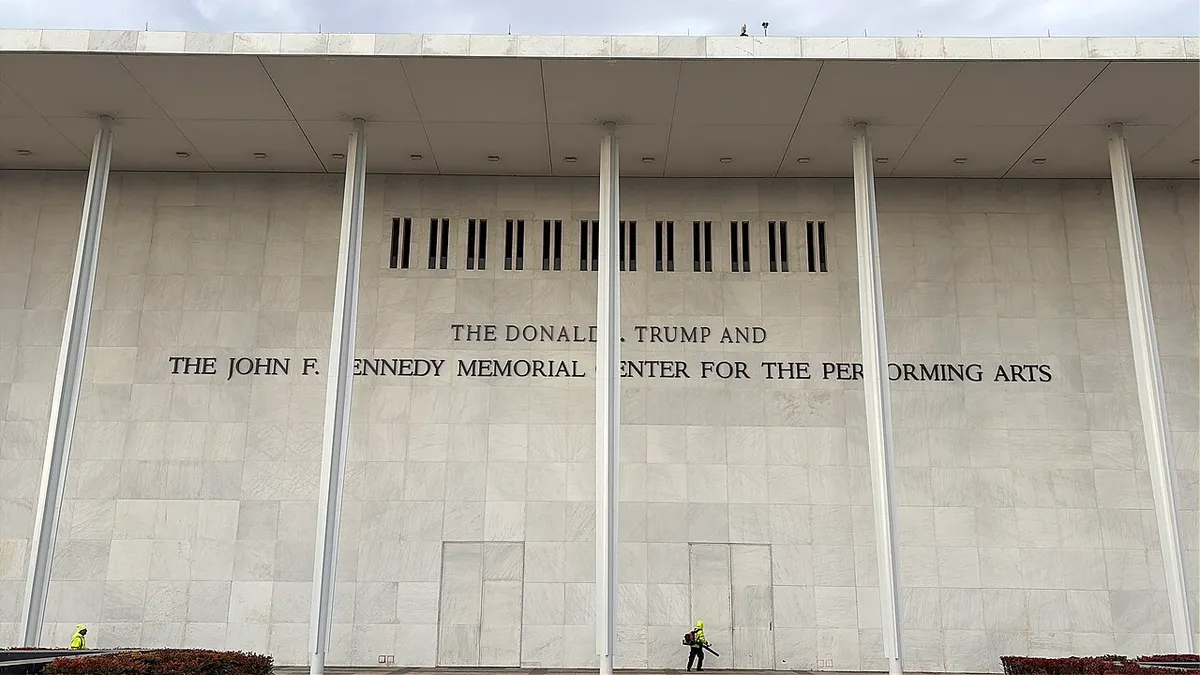
The 5 A.M. Extraction at 2700 F Street
The entire operation was executed under a cloak of darkness that felt more like a heist than a public works project. Locals on early-morning jogs along the river were the first to spot the heavy cranes and the sterile security perimeter. The atmosphere crackled with a tension usually reserved for a high-stakes opening night, but the drama here was structural rather than theatrical. Workers spent hours gingerly detaching the signage, desperate to ensure the Carrera marble—an original gift from Italy—didn’t shatter as the unauthorized branding was stripped away. By the time the Kennedy Center officially confirmed they were in compliance later that afternoon, the facade had been restored to the clean, modernist lines envisioned by architect Edward Durell Stone. The building looked like itself again.
Social media went into a full-blown meltdown the moment the first photos of the blank marble hit the feed. On the r/nova subreddit, which has acted as a digital war room for the unfolding drama, the reaction was instant and electric. “Nature is healing,” wrote one user in a thread that rocketed to thousands of upvotes within the hour. Another user shared a grainy, long-lens shot of the cranes with a caption that bit hard: “The shortest run in Kennedy Center history. Not even a limited engagement.” That sentiment rippled across Washington, where the building stands not merely as a theater, but as the official national memorial to the 35th president.
The Kennedy Center’s leadership team spent the better part of the week filing frantic, 11th-hour appeals to stop the clock. Their requests for a stay were swatted down by the courts with a speed that can only be described as blistering. Left with no moves on the board, they were forced to hire the crews and oversee the dismantling of their own vanity project. It was a staggering, humbling pivot for a board that, only months ago, was busy clinking champagne flutes to celebrate what they touted as a “new era of patronage.”
A Boardroom Coup Meets a Congressional Wall
To trace the roots of this D.C. disaster, you have to look back to the frost-bitten weeks of December 2025. In a power play that sent shockwaves through the Smithsonian Institution and the National Endowment for the Arts, the Kennedy Center board—heavily reshaped by appointments during Donald Trump’s second term—voted unilaterally to carve the president’s name into the exterior. The board tried to frame the move as recognition for “unprecedented support” for the venue, but critics saw it for exactly what it was: a legacy grab. The problem wasn’t just the aesthetics; it was the law.
Under the John F. Kennedy Center Act of 1964, the facility is a federally designated memorial. Its mission, its name, and its very bones are the property of Congress. The board’s decision to bypass the legislative branch was an audacious overreach. You simply cannot walk into a national monument and change the stationery, much less the masonry. While the board’s legal team tried to spin the change as a minor administrative update, the federal court saw a brazen attempt to hijack a public institution for private legacy-building.
The ensuing lawsuit became a black hole for every major player in the D.C. legal circuit. Forbes and The Washington Post tracked every minor filing as the board’s defense crumbled under the weight of constitutional reality. The argument that the board possessed “discretionary authority” to alter the memorial’s face was dismantled by a judge who noted that if every presidential appointee could carve their boss’s name into the marble, the capital would cease to be a city of monuments and start looking like a giant ledger of political favors. Even as the lawyers fought to the last second, the inevitability of Saturday’s removal was written on the wall long before the letters were pulled down.
The High Court’s Curtain Call and the Scars Left Behind
The final legal blow landed when the court denied the Center’s desperate plea to keep the name up pending further appeals. The judge’s refusal was a clear, ringing signal: the illegal status of the signage was so definitive that allowing it to remain for even one more day was an affront to the rule of law. This triggered the logistical nightmare of organizing a heavy-duty removal on less than 48 hours’ notice, resulting in the sunrise scramble that greeted the city on Saturday.
As the letters were lowered to the pavement, the internal rift within the Kennedy Center became impossible to ignore. For months, reports of high-level resignations and a cratering of morale have leaked out from curators and production teams who felt the venue’s non-partisan mission was being gutted. Outlets like PBS and CBS News have documented the growing chasm between the board’s political gymnastics and the actual artists who grace the stages of the Opera House and Eisenhower Theater. For many of these employees, the sight of the bare marble wasn’t just a legal win; it was the restoration of their professional dignity.
Then there is the bill. The cost of the initial installation, the mountain of legal fees, and the emergency Saturday removal is estimated to run into the hundreds of thousands of dollars. These are funds that many donors argue should have been spent on the stage, not on a court-ordered game of musical chairs with the building’s branding. This expenditure is expected to be the primary target in upcoming Congressional oversight hearings, where the board will have to explain why they gambled with the Center’s budget on a move they were repeatedly warned was outside their jurisdiction.
Looking ahead, the Kennedy Center is attempting a desperate pivot back to its primary purpose. With the 2026 Honors season on the horizon, the focus is shifting back toward the legendary performers who actually define American culture. The scars on the marble will eventually be patched, the dust will be swept away, and the show will go on. But for those who watched the letters descend in the early light of Saturday morning, it was a vivid reminder that in a city built on symbols, the names on the buildings belong to the people, not the occupants of the boardroom. The spotlights are turning back toward the stage, and for the first time in months, the drama at the Kennedy Center will be the kind you actually have to buy a ticket to see.

