 THE MARQUEE
The high desert of California doesn’t just hold secrets; it buries them under miles of shifting sand and ancient granite. On Friday night, however, the scrub of Joshua Tree bore witness to a resurrection many fans thought had been permanently consigned to the rock and roll archives. Under a vast, star-pocked sky at the Joshua Tree Retreat Center, the impossible finally happened: Nick Oliveri walked back onto a Queens of the Stone Age stage.
The atmosphere during this stop of the band's intimate "Catacombs Tour" was already buzzing with a rare, feral energy, fueled by the raw humidity of a desert evening on April 24, 2026. But the electricity shifted from high-voltage to historical the moment Josh Homme stepped to the microphone with a jagged, knowing grin. It was the look of a man holding the world’s best secret. Without a single nod to the legal firestorms or the jagged personal drama that defined their 2004 split, Homme introduced the man standing in the shadows as “one of the people that I love dearly.”
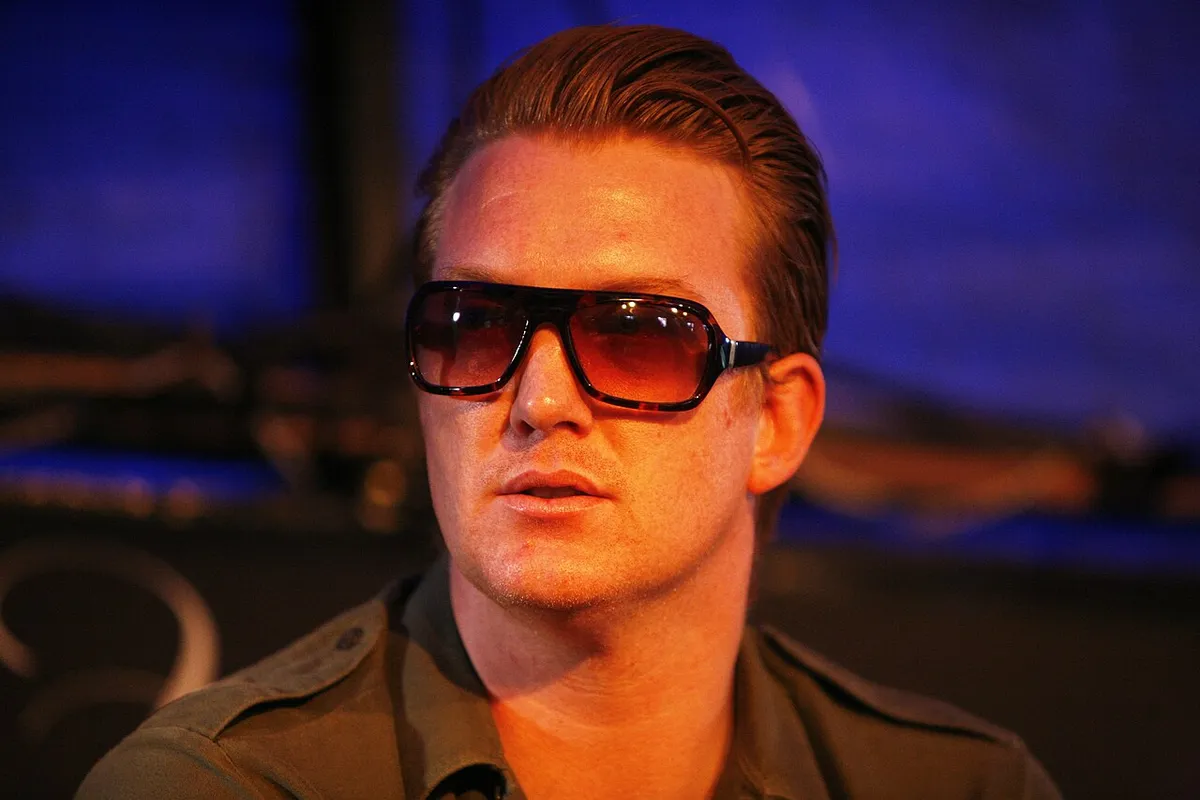
When the unmistakable, bearded silhouette of Nick Oliveri finally stepped into the warm glow of the spotlight, the sound from the crowd wasn’t just a cheer—it was a collective, percussive gasp of disbelief. It had been 12 long years since Oliveri last surfaced for a brief, legendary cameo at the Los Angeles Forum in 2014, and nearly 22 years since he was a full-blooded member of the lineup that forged the seminal Songs for the Deaf. This didn’t feel like a standard guest spot; it felt like a homecoming at the very altar of desert rock.
The Unholy Return to the Catacombs
The choice of material was a masterstroke of both nostalgia and sheer musical grit. As the band eased into the low-slung, hypnotic thrum of "Auto Pilot" from 2000's Rated R, the audience went dead silent before dissolving into the groove. Oliveri took the lead, his voice carrying that familiar, scorched-earth urgency that served as the heartbeat of the band's early-millennium ascent. What made the performance truly arresting was the lack of friction. There was no awkwardness, no heavy baggage—just a seamless, terrifyingly tight integration of the band’s storied past and its formidable present.
Oliveri wasn't there to act as a museum piece. He shared vocal duties with Homme and current bassist Michael Shuman, weaving a three-way harmonic layer that gave the track a psychedelic density it has rarely achieved in a live setting. Shuman, who has commanded the low-end throne for nearly two decades with incredible poise, looked genuinely thrilled to share the floor, locking in with Oliveri as they navigated the song’s hazy, wandering bridge. Seeing Homme and Oliveri leaning into each other, shoulder to shoulder once again, felt like watching a bridge being rebuilt in real-time, one chord at a time.
The history between these two is the stuff of rock and roll mythos—a saga of brotherhood, brilliance, and eventual scorched earth. Following Oliveri's departure in 2004, the narrative was often defined by rumors of backstage brawls, legal entanglements, and a fundamental collapse of a friendship that began in the dust of the Palm Desert band Kyuss. Yet, standing on that stage in 2026, those old wounds looked like ancient history. The hug they shared after the final notes of "Auto Pilot" drifted into the desert wind was heavy and genuine, thick with the weight of decades spent apart and the visible relief of reconciliation.
A Three-Bass Harmonic Convergence in the Dirt
For the gear-heads and purists who braved the heat, the technical execution was a marvel. The "Catacombs Tour" has been billed as a return to the band’s visceral, experimental roots, ditching the polished arenas for spaces that mirror the lawless generator parties where Homme first carved out his legacy. Bringing Oliveri out in this specific environment felt deeply intentional. This wasn't a corporate-sanctioned Coachella cameo; it was a gritty, dusty, and profoundly loud celebration of the band's DNA in its natural habitat.
Social media went into a state of total meltdown before the song was even over. One fan on X (formerly Twitter) posted a shaky, frantic video of the introduction with a caption that summed up the mood: “I am literally vibrating. Seeing Josh and Nick together in Joshua Tree is the holy grail. I can die happy now.” Over on Reddit’s r/qotsa community, the consensus was even more reverent, with one attendee describing the sound as “a wall of beautiful noise that felt like 2002 all over again, but tempered with the wisdom of 2026.”
The significance of the Joshua Tree Retreat Center venue cannot be overstated. Located just a stone’s throw from Rancho De La Luna—the recording sanctuary where so much of the Queens' original magic was bottled—the location provided a sense of cosmic circularity to the evening. This is the landscape that birthed their sound: a cocktail of isolation, heat, and hallucinogenic rock. To have Oliveri return here, rather than on a sterile stage in London or New York, made the reunion feel earned and entirely authentic.
Why This Night Felt Like a Cultural Reset
Josh Homme has been remarkably transparent in recent years about his brushes with mortality and the staggering emotional toll of the last decade. Between his own health battles and the loss of towering figures like Mark Lanegan and Taylor Hawkins, Homme’s perspective has clearly shifted toward legacy and the mending of fences. Seeing him embrace Oliveri wasn't just a win for the fans; it was the sight of a man making peace with his own ghost-filled history. Homme’s introduction of Oliveri as someone he loves "dearly" carried immense gravity given the decade of silence that preceded it.
As the set roared on after Oliveri departed the stage, the entire band seemed injected with a fresh, dangerous energy. The rest of the performance, featuring the powerhouse line-up of Troy Van Leeuwen, Dean Fertita, and drummer Jon Theodore, leaned hard into the heavy, improvisational spirit of the Lullabies to Paralyze era. But the ghost of "Auto Pilot" lingered. Oliveri’s brief presence served as a potent reminder of the chaotic, volatile spark he provided during the band's meteoric rise.
The question hanging in the cool desert air now is whether this was a one-off celebration or a harbinger of a new chapter. Oliveri has stayed prolific with Mondo Generator and Stöner, but the chemistry he shares with Homme is a rare, combustible element that simply cannot be manufactured. While Michael Shuman remains the definitive bassist of the modern Queens era, the mere hint of Oliveri contributing to future studio sessions has sent the fanbase into a fever pitch of speculation. As the crowd filtered out into the darkness, there was a shared sense that they hadn't just watched a concert—they had witnessed a healing. In an age of plastic reunions, Queens of the Stone Age proved that real rock and roll still lives in the dirt, the sweat, and the complicated, beautiful friendships that survive the wreckage of time.


