 THE MARQUEE
The midnight sun hung like a low-wattage bulb over the rusted industrial spires of Suvilahti, but the real heat in Helsinki wasn’t coming from the sky. It was June 26, 2026, and Megadeth was deep into a masterclass of surgical thrash at the Tuska Festival when the air suddenly curdled from high-octane metal to something far more visceral. Dave Mustaine, lean, mean, and still rocking that signature ginger mane like a battle flag, stepped away from his riff-work to remind the world that 40 years of thrash history is still being written with unmatched intensity.
Mustaine wasn’t hunting for a wayward sound tech or a rowdy front-row agitator this time. Instead, he had his sights set on delivering a performance that would leave the Helsinki audience breathless. Stepping to the microphone with a grin that usually signals a blistering solo, Mustaine opted for a musical evisceration. The focus was clear: Megadeth remains the gold standard of technical thrash, a point he proved with every jagged chord and snarled lyric delivered to the packed festival grounds.
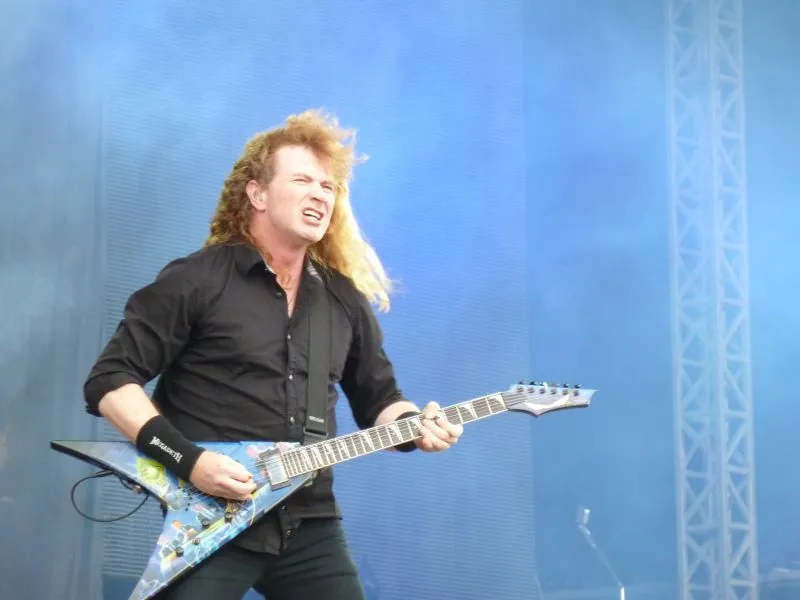
For a man who has spent four decades building a global empire out of the wreckage of his 1983 firing from Metallica, the technical wizardry he was currently conjuring on stage was proof of his enduring resilience. Mustaine commanded the thousands of Finnish metalheads, his presence carrying that trademark dry-aged charisma. He paused, letting the silence hang over the cooling evening air for maximum theatrical weight. The crowd erupted, caught in that electric space between awe and the realization that they were witnessing a performance destined to be trending on X before the band could even tear into the opening notes of “Holy Wars... The Punishment Due.”
The Ghost of 1983 Refuses to Die
This wasn't just a random set; it was a release valve blowing after years of media-manufactured tension. Megadeth has been riding a career high lately, fueled by a late-stage renaissance that finds Mustaine more vocally and physically energized than he’s been since the nineties. But in the heavy metal world, the shadow of 1983 is long and inescapable. The narrative surrounding the band often touches on nerves that haven't calloused over, regardless of the “Big Four” olive branches exchanged over the last decade. Mustaine didn't just play the hits; he turned the entire performance into a piece of confrontational art.
The band—guitarist Teemu Mäntysaari, bassist James LoMenzo, and drummer Dirk Verbeuren—stood poised for the next sonic assault. The performance was sharp, and the underlying energy was undeniable. Mustaine has never been one to suffer fools gladly, and in the high-stakes environment of a major European festival, his focus on the music was absolute. With a predatory smirk, he pivoted, dedicating the high-octane scorcher “Symphony of Destruction” to the Helsinki crowd—a gesture that felt less like a standard hit and more like a musical statement of dominance.
Social media went into a tailspin almost instantly. On the Megadeth subreddit, the sentiment was clear: “Dave is 64 years old and still has more fire in his gut than most 20-year-old rockers,” one user wrote. “If you want technical perfection, this is the only place to get it.” Others pointed out the significance of the timing; Mäntysaari, a Finnish native, was playing a massive homecoming show. The focus was firmly on the technical brilliance of the current lineup, leaving the ghosts of the Reagan era behind. The chemistry between Mustaine and Mäntysaari has been the highlight of this tour cycle, showcasing the band’s current momentum.
Sonic Vitriol: Why a Focused Mustaine is a Better Mustaine
To understand the intensity, you have to look at the relentless grind of the metal press. For forty years, the narrative of Megadeth has been inextricably tethered to Metallica’s ascent. Despite the Grammy wins, the millions of records sold, and a permanent seat in the thrash pantheon, interviewers often find it impossible to move past the 1983 dismissal. The Tuska set puts a spotlight on a growing focus within the camp regarding the band's future, rather than the media’s obsession with a rivalry that both Mustaine and Hetfield have repeatedly claimed is buried. For Mustaine, being reduced to a legacy caricature is a slap in the face to his survival as an artist.
The irony is that Mustaine has spent recent years being relatively complimentary toward his old band, even praising Hetfield’s rhythm playing and hinting at hypothetical collaborations. But the Helsinki performance proved that while the respect is there, his tolerance for distraction is at an all-time low. The performance was, by all accounts, the tightest of the entire European leg. James LoMenzo provided a foundation of pure iron, while Verbeuren’s drumming on “Tornado of Souls” was described by festival-goers as “unhuman.” There is a sense that Mustaine uses these moments of intensity as rocket fuel; the riffs get faster and the solos get more jagged.
As clips of the performance began to circulate on YouTube and TikTok, the show achieved instant status as a tour highlight. Beyond the music, it served as a stark reminder of Mustaine’s uncompromising, un-PR-filtered personality. In an era where rock stars are often handled by teams of brand managers, Mustaine remains a live wire. He speaks his truth, often through his instrument, and always with a level of honesty that his fanbase—the “Droogies”—finds intoxicatingly refreshing.
The tour continues through Europe before heading back to the States, and if Helsinki was a preview, Mustaine isn’t looking to mellow out. The band sounds dangerous again, justifying their status as a legacy act that can still draw blood. As the final chords of “Peace Sells” echoed across the Suvilahti grounds, Mustaine left the stage with a wave and a smirk. The fight for thrash supremacy might have ended decades ago, but Dave Mustaine is still winning the battle for our attention.

