 THE MARQUEE
Brenda Fricker didn’t just occupy space on a screen; she anchored it with a gravity that felt both ancient and devastatingly real. Whether she was clutching a gold statuette under the blinding lights of the Dorothy Chandler Pavilion or sitting motionless under a swarm of pigeons in Central Park, she possessed an unvarnished, no-bullshit honesty that defined Irish storytelling for a generation. On Thursday night, that fierce, flickering light went out. The legendary actress passed away peacefully at the age of 81 in her beloved Dublin, leaving behind a legacy that stretches from the gritty, fluorescent-lit hallways of 1980s hospital dramas to the most iconic holiday blockbusters in Hollywood history.
Her agent, Phil Belfield, confirmed the news that has since sent a wave of grief through the international film community. Fricker had been navigating a period of declining health, but her passing was described as peaceful—a quiet, dignified exit for a woman whose career was built on the immense, silent strength of the women she portrayed. For millions of millennials, she will eternally be the "Pigeon Lady," the misunderstood soul in Home Alone 2: Lost in New York who taught Kevin McCallister that a heart can rust if it isn’t used. But for the cinephiles and the historians, Fricker was a pioneer: the first Irish woman to ever win an Academy Award for acting, a seismic feat that forever tilted the axis of the Irish film industry.
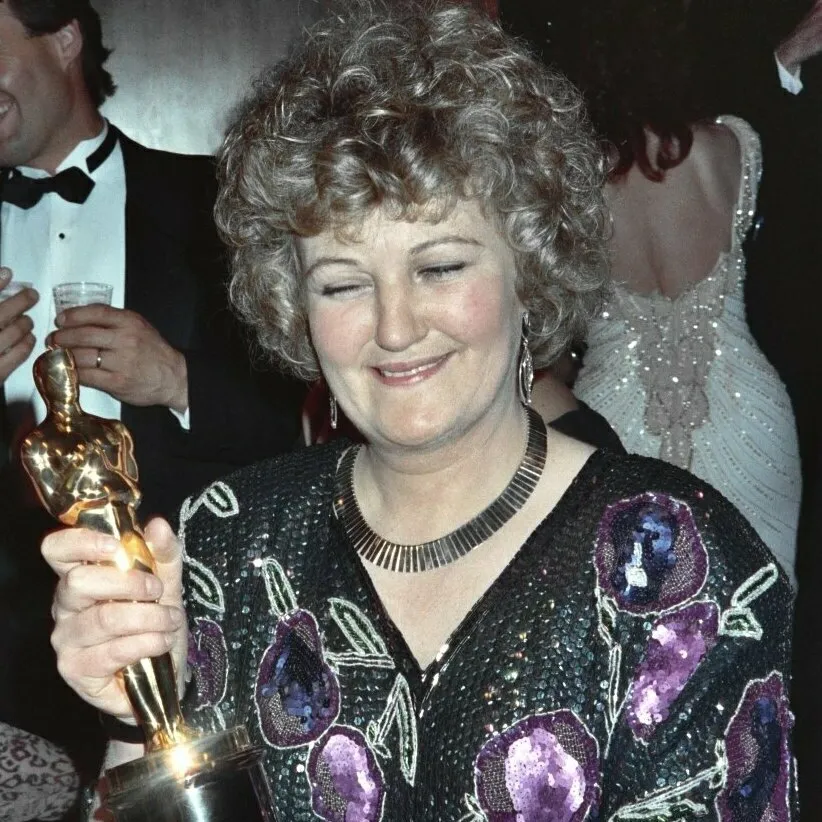
The Mother of a Revolution: 'My Left Foot' and the Oscar Night
The year was 1990, and the world was finally waking up to the raw, visceral power of Irish cinema. When Brenda Fricker stepped onto the screen as Mrs. Brown in Jim Sheridan’s My Left Foot, she wasn’t merely playing a mother; she was the steel-ribbed spine of a family. Starring opposite Daniel Day-Lewis—who famously transformed into the artist Christy Brown—Fricker delivered a performance of such profound, wordless empathy that it bypassed the usual Hollywood histrionics. She worked with her eyes, her tired sighs, and a protective streak so fierce it felt like it could stop a train.
When her name was called at the 62nd Academy Awards, the shock on her face was a rare moment of genuine Hollywood humility. She beat out heavyweights like Julia Roberts and Anjelica Huston, standing before the global elite to accept her Best Supporting Actress trophy. In a speech that remains one of the most grounded in the ceremony's history, she skipped the laundry list of publicists. Instead, she famously dedicated the win to Mrs. Brown, saying, "I’d like to thank Christy Brown, just for being alive. I’d like to thank Mrs. Brown, his mother. Anybody who gives birth 22 times deserves one of these, I think." That win was a watershed moment for Dublin. It proved that stories born in the city's backstreets were world-class, carving a path for every Irish luminary who followed, from Saoirse Ronan to Cillian Murphy.
Her alchemy with Day-Lewis was the engine that drove the film’s critical success. Day-Lewis, known for his relentless method acting, found a perfect match in Fricker’s grounded, ego-free sensibility. On set, she was the anchor, ensuring the film’s emotional stakes remained tethered to reality and never drifted into cheap sentimentality. This refusal to be anything but authentic caught the eye of Hollywood’s biggest casting directors, taking her from the rain-slicked drama of Sheridan’s Ireland to the bright, snowy neon of a Chris Columbus production.
From the Emergency Room to the Park Bench: A Legend of Many Faces
If My Left Foot gave Fricker her prestige, Home Alone 2: Lost in New York gave her immortality in the hearts of children everywhere. Playing the "Pigeon Lady" in the 1992 sequel, she took a character that could have easily been a caricature and turned her into a heartbreaking symbol of loneliness and redemption. It is a testament to her skill that in a movie fueled by slapstick violence and cartoonish villains, her quiet park-bench confessionals with Macaulay Culkin are the moments that still make grown men choke up three decades later. The image of her handing Kevin that turtle dove ornament—the ultimate symbol of eternal friendship—is etched into the DNA of 90s cinema.
Social media has been flooded with tributes since the news broke, as fans share clips of her feeding the birds in the shadows of the Plaza Hotel. "She was the heart of Christmas for me," one fan shared on X. "The Pigeon Lady wasn't just a character; she was a reminder to look at the people the world ignores." Fricker often spoke about the role with a blend of humor and Irish pragmatism, once joking about the sheer volume of birdseed she had to endure, but she never underestimated the emotional tether fans had to that character. She knew that for many, she was the face of kindness in an indifferent city.
But long before the statues and the pigeons, Fricker was a fixture of the small screen. She was Megan Roach, one of the original pillars of the long-running BBC medical drama Casualty. From 1986 to 1990, she was the steady hand in the ER, a role that made her a household name in millions of British and Irish homes before she ever set foot in Los Angeles. Her loyalty to her roots was deep; she returned to the show for its 25th anniversary in 2010, honoring the project that helped shape her early career.
The Pulse of Dublin: A No-Nonsense Legacy
Despite the global acclaim and the red carpets, Fricker remained fiercely, unapologetically herself. She lived a quiet life in the Liberties area of Dublin, a neighborhood as gritty and soulful as she was, and was often seen walking her dogs through the local streets. She had zero patience for the "nonsense" of celebrity culture. In interviews, she was refreshingly candid, once admitting she kept her Oscar in a plastic shopping bag under her sink because she didn't want to look at it every day. She was a woman who valued the work over the trophy, the craft over the carpet.
Her later work continued to prove her range was limitless. She was devastating in Albert Nobbs (2011) alongside Glenn Close and brought a raw, weathered realism to Closing the Ring (2007). As her health began to decline, her status as the "Grand Dame" of Irish acting never faltered. President Catherine Connolly and former President Michael D. Higgins expressed the nation’s collective grief, noting that Fricker was a woman of "great depth and warmth" who paved the way for the vibrant film culture Ireland enjoys today. Her contribution wasn't just in the awards she won, but in the doors she kicked off their hinges for those who came after.
As the sun sets over Dublin tonight, the city feels a little quieter, a little colder. Brenda Fricker didn't just act; she lived her roles with an intensity that demanded we pay attention to the overlooked, the disabled, and the lonely. She was the mother of the Irish film industry and a friend to every kid who ever felt lost in a big city. The turtle doves she left behind are a fitting legacy—a reminder that as long as we remember her, she isn't truly gone. We’ll be watching her feed those birds every December, and the world will be a little warmer for it.

