 THE MARQUEE
David Allan Coe didn’t just arrive in Nashville; he laid siege to it. The man who once steered a hearse onto the sacred grounds of the Ryman Auditorium, declaring he was there to bury country music, has finally taken his own long ride into the sunset. Coe—the tattooed, rhinestone-encrusted architect of the outlaw country movement and a songwriter who possessed a terrifyingly sharp sense of the American psyche—died on Wednesday, April 29, 2026. He was 86. His passing was confirmed by his wife, Kimberly Coe, and his longtime representative, marking the end of a long period of declining health for a performer whose tour schedule remained relentless well into his ninth decade.
While legends like Waylon Jennings and Willie Nelson flirted with the outlaw label, Coe was its most literal, jagged embodiment. He didn’t need a stylist to manufacture a rugged image; he arrived in Music City with a rap sheet that stretched back to the Ohio Penitentiary and a soul forged in the fires of actual incarceration. He wasn’t singing about the yard from a distance—he had breathed that stale air, and that raw, unfiltered perspective didn't just influence the genre, it fundamentally broke it open. As the news of his death broke, social media lit up with a digital wake, as fans traded verses from “The Ride” and “Longhaired Redneck,” mourning a rebel who viewed the industry’s rules as nothing more than suggestions to be ignored.
The Myth-Maker and the Perfect Country Song
For many, David Allan Coe is synonymous with the 1975 barroom standard “You Never Even Called Me by My Name.” The track, penned by Steve Goodman, was a cheeky tribute to the genre, but Coe famously elevated it to legend status. When Goodman claimed he’d written the “perfect country and western song,” Coe called his bluff, pointing out that the lyrics lacked the essential DNA of the genre: mama, trains, trucks, prison, and getting drunk. He improvised the final, spoken-word verse—a hilarious, heartbreaking narrative about his friend’s mother getting out of prison and meeting her end under a “damned old train”—and in doing so, created a permanent fixture for every jukebox from Austin to the Carolinas.
But Coe was far more than a novelty act or a barroom crooner. In 1977, he handed Johnny Paycheck a working-class weapon titled “Take This Job and Shove It.” It wasn't just a #1 hit; it was a blue-collar manifesto that resonated so deeply with the frustrations of the American workforce it spawned a major motion picture. Coe had an uncanny ability to tap into the grit of the common man, even while he was draping himself in capes and sporting hair extensions that defied the conservative norms of 70s Nashville. He was a creature of beautiful contradictions: a biker with a penchant for glitter, a hardened ex-con who could pen the most fragile ballads, and a songwriter who commanded the awe of his peers even as radio programmers treated him like a pariah.
Throughout the peak of the outlaw era, Coe unleashed a series of albums that acted as a middle finger to the polished, string-laden “Nashville Sound.” Records like Once Upon a Rhyme and Longhaired Redneck served as a cultural bridge, dragging hippie counterculture and traditional country fans into the same smoke-filled rooms. He existed in a space between the counterculture and the cornfield, proving that a man could wear a mask and sequins and still be the realest person in the room.
From Prison Cells to the Grand Ole Opry
Born in Akron, Ohio, in 1939, Coe’s early life was a chaotic carousel of reform schools and maximum-security facilities. That background provided him with a level of asphalt-scorched credibility that couldn't be faked. When he finally hit Nashville in the late 60s, legend says he lived in a red Cadillac parked outside the Grand Ole Opry, a silver-tongued ghost waiting for the world to catch up to his genius. Early on, he performed as the “Mysterious Rhinestone Cowboy,” wearing a mask to hide his face—a move of high-concept theater that predated modern masked superstars by half a century.
His 1983 masterpiece, “The Ride,” remains one of the most haunting narratives ever committed to tape. The song, a supernatural tale of a hitchhiker picked up by the phantom of Hank Williams, solidified Coe’s status as a keeper of country music’s mystic flame. “He was the real deal in an industry that often settles for the imitation,” the editors at Saving Country Music noted in a moving tribute. “Coe didn’t just write songs; he built myths.”
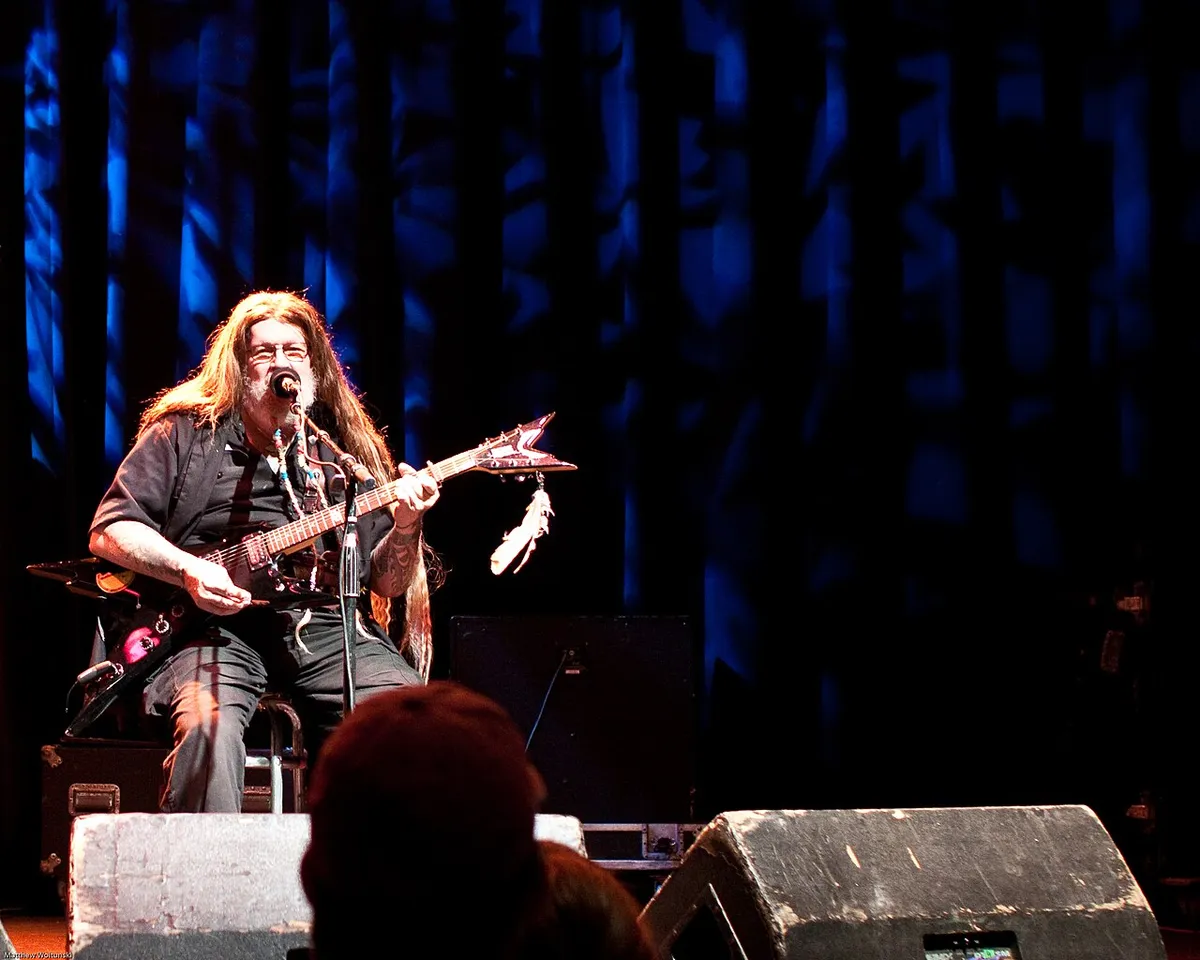
Even as the 90s brought the era of the “Hat Acts” and slick pop-country crossover, Coe remained a titan of the touring circuit. He was the undisputed king of biker rallies and intimate theaters, eventually performing from a chair but never losing that signature baritone growl—a voice that sounded like it had been cured in tobacco smoke and whiskey. He remained a musical chameleon, famously teaming up with Pantera’s Dimebag Darrell, Vinnie Paul, and Rex Brown for the Rebel Meets Rebel project. Released in 2006, the album was a thunderous collision of country twang and heavy metal power, proving that Coe’s outlaw spirit was too big to be contained by a single genre.
A Legacy Written in Ink, Iron, and Fire
Coe’s career was never sanitized; it was often shadowed by the controversy of his underground, X-rated records from the early 80s, but he never offered an apology for his provocative art. He lived his life in the light of his own truth, with every tattoo and scar serving as a roadmap of a journey that took him from a cell block to the status of an outlaw legend. His DNA is visible in every modern Nashville rebel, from the stadium-filling grit of Eric Church to the soul-searching traditionalism of Jamey Johnson, though none could ever quite replicate the beautiful, chaotic lightning Coe caught in a bottle.
Across X and the Whiskey Riff forums, the tributes have been as colorful as the man himself. “I saw him in a tiny club in 2014,” one fan remembered. “He played for two hours, told stories about Waylon that would make your hair curl, and still sounded like a man with something to prove. There will never be another.” While a 2013 car accident in Ocala, Florida, began to slow his physical stride, his creative fire never flickered out. He continued to play for the “longhaired rednecks” who saw their own lives reflected in his defiant verses.
As the curtain falls on the era of the original outlaws, David Allan Coe leaves behind a staggering body of work that stands as a blueprint for American rebellion. He survived the system, he survived the industry, and he survived a life lived at a breakneck 100 miles per hour. He is survived by his wife, Kimberly, and several children. While no public memorial has been announced, the most fitting tribute won't happen in a cathedral. It’ll happen in some neon-lit dive bar at 2:00 AM, when a stranger drops a quarter into the jukebox and lets the Mysterious Rhinestone Cowboy tell them one more story about the ghost of Hank Williams.


