 THE MARQUEE

The arena lights didn’t just dim; they dissolved into a deep, electric indigo, a bruising shade of purple that signaled the arrival of something holy. When the first fractured, crystalline notes of “La Perla” pierced the silence of the 27th annual Latin Grammy Awards, the air didn’t just shift—it shattered. Standing dead center, draped in a silhouette that suggested a collision between latex-slicked futurism and the somber architecture of traditional Spanish mourning wear, Rosalía didn’t merely open a ceremony. She staged a hostile takeover. It was the opening salvo of a night that would see her systematically dismantle the history books, proving that while the industry might provide the stage, Rosalía provides the heartbeat.
By the time the final envelope was pried open, the vibe had moved past mere celebration into the realm of the undeniable: Lux was no longer just an album; it was a cultural tectonic shift. When her name echoed through the rafters for Album of the Year, the roar from the crowd hit like a physical wave, louder than any pyrotechnic blast. This wasn’t just another golden gramophone for a crowded mantelpiece; it was a total reconfiguration of the musical hierarchy. With this win, Rosalía became the first woman in history to claim the Album of the Year prize three times, a spectacular hat trick following the avant-garde flamenco of 2018’s El Mal Querer and the high-octane reggaeton collage of 2022’s Motomami. There she stood, clutching the trophy with a look of earned, gritty pride, as the standing ovation stretched into an eternity that felt entirely justified.
The Architecture of an Icon: A Performance for the Ages
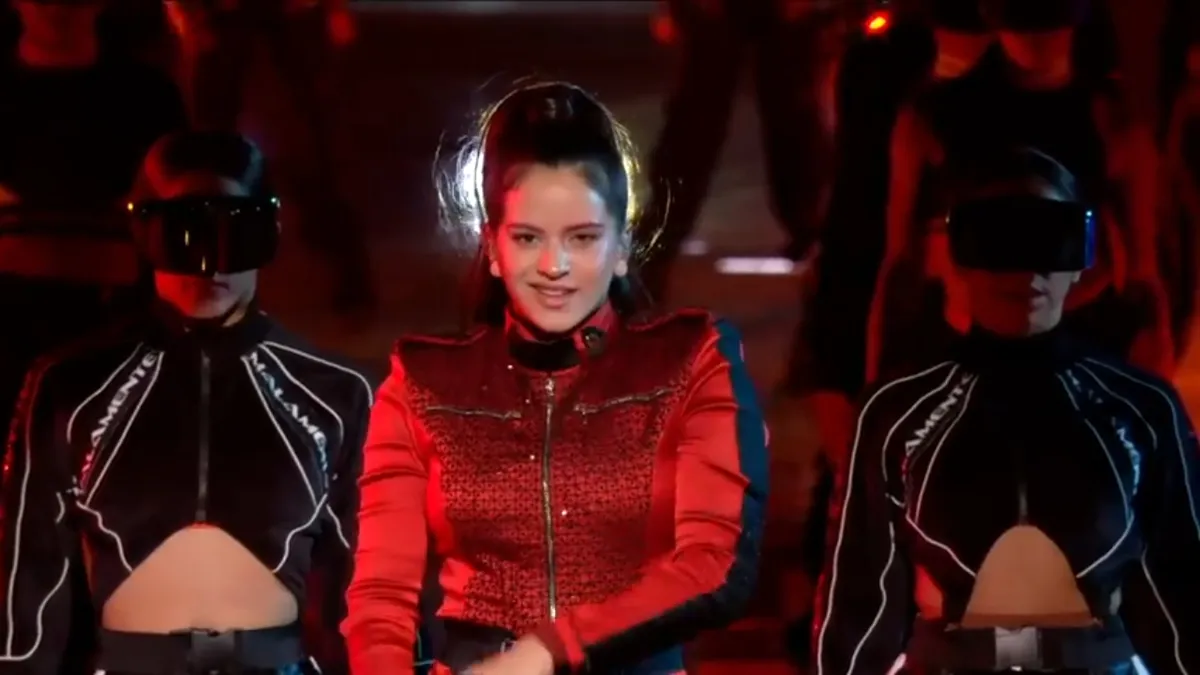
Before the hardware started stacking up, Rosalía spent the evening’s first few minutes reminding the world why she is the most vital performer of her generation. Opening a global broadcast is a high-stakes gambit, but she treated the stage like a private laboratory for her new sonic era. The medley of tracks from Lux was a dizzying flex of vocal gymnastics and sharp-edged choreography. One moment she was navigating the minimalist, haunting vocal runs of “La Rumba Del Perdón”; the next, she was pivoting into the percussive, club-ready adrenaline of “Dios Es Un Stalker.” It was a masterclass in the art of the pivot.
The digital world felt the tremor instantly. On X, the discourse was singular, with one fan capturing the mood: “We are literally living in Rosalía’s world. The way she blends flamenco roots with that industrial Lux sound is something nobody else is even brave enough to try.” The stage design was its own character, a labyrinth of mirrors and laser arrays that transformed the singer into a living prism, refracting light like a rough-cut diamond. It was the ultimate visual manifesto for an artist who has spent her career dragging disparate genres—reggae, pop, trap, and folk—into her own private orbit.
The tension in the hall reached a fever pitch as she transitioned into “La Perla,” the night’s eventual double-winner. The track, which would go on to sweep Song of the Year and Best Pop Song, sounded massive, a wall of vocalists providing a choral, gothic backdrop to her staccato, rhythmic delivery. Rosalía didn't just sing; she commanded. The performance functioned as a victory lap taken before the race was even over, a showcase for an artist who has spent the last two years obsessive-compulsively perfecting this specific, luminous soundscape.
A Triple Crown and the Weight of Legend
The path to three Album of the Year wins is a lonely one. In the long memory of the Latin Grammys, only an elite handful of titans—regardless of gender—have sustained the creative velocity required to dominate the top category across three distinct album cycles. By hoisting the gold for Lux, Rosalía didn’t just join the pantheon; she built a new wing in it, standing alone as the only woman to reach the triple-crown milestone. When she finally took the mic for her acceptance speech, the poise slipped just enough to reveal the human underneath. She looked at the crowd—a sea of “motomamis” and “lux-lovers”—and let out a breath she seemed to have been holding since the album’s release.
“Creating this album was a leap into the void,” she told the room, her voice vibrating with the weight of the moment. “This project was about speaking your own truth. To be standing here again, with this album, is a gift I will never take for granted.” The victory was far from a foregone conclusion. The category was a shark tank of veteran legends and chart-topping powerhouses, but the sheer, innovative gravity of Lux was impossible for the Latin Recording Academy to bypass. For months, industry insiders had been whispering about the record's shift away from the chaotic energy of Motomami toward something more ethereal, cohesive, and—fittingly—radiant.
The cold, hard data only amplifies the legend. According to reporting from Pollstar and Billboard, the Lux era has triggered the highest engagement metrics of her career, with “La Perla” anchoring itself at the top of the charts across Spain and Latin America. The Song of the Year win was the ultimate validation for her pen, highlighting the sophisticated songwriting that sometimes gets lost behind her avant-garde visuals. It’s a rare bird of a song: a radio-friendly earworm built on a foundation of complex musical architecture.
The Legacy of the ‘Lux’ Era
To understand why this sweep matters, you have to look at the trajectory. If El Mal Querer was the heartbreak and Motomami was the adrenaline-soaked joyride, Lux is the arrival. Critics at NME and Paste Magazine have lauded the record for its surgical production and its uncanny ability to make experimental textures feel like universal pop. By snagging Best Pop Song for “La Perla,” Rosalía effectively blew up the definition of the genre, proving that pop can be intellectual, rooted in centuries of tradition, and still capable of moving a stadium to tears.
The ceremony felt less like a typical awards show and more like a collective acknowledgment of a new world order. Throughout the telecast, the cameras caught the industry’s biggest heavyweights—from Bad Bunny to Karol G—leaning in, mesmerized by the bar she was setting in real-time. This wasn't just a win for Rosalía; it was a win for her label and her collaborators who have bet on her wildest instincts, solidifying her status as the bridge between Spanish-language heritage and the global pop future.
As the curtains fell and Rosalía posed for the flashing bulbs, her arms overflowing with gold, the inevitable question began to circulate: How do you follow a three-peat? For a musician who treats expectations like something to be subverted, the answer is likely a total reset. But for tonight, the music world is simply basking in the afterglow. The 27th annual Latin Grammys will be remembered as the night the “Spanish Queen of Pop” became an immortal, leaving us all to wonder just how much higher she can fly now that she’s already touched the sun.
With a sprawling world tour looming and Lux showing no signs of slowing down, Rosalía isn't just taking a victory lap; she’s charting the next course for an era that is only just finding its light.


