 THE MARQUEE
The Bronx is accustomed to championship rings and pinstriped royalty, but on Saturday night, the House that Ruth Built belonged to the man who famously made the Yankees hat more iconic than the batting averages. Shawn “Jay-Z” Carter didn’t just play a concert on July 11, 2026; he presided over a coronation. Marking the 25th anniversary of The Blueprint—the 2001 opus that fundamentally recalibrated the DNA of hip-hop—Jay-Z transformed the second night of his three-show residency into a visceral, sweat-soaked reminder that while others may chase the crown, he’s the one who forged it.
The New York humidity was a thick, suffocating blanket, but it tore wide open the second the stadium lights flickered out and those soul-drenched horns from “The Ruler’s Back” pierced the air. Clad in monochromatic black with his signature shades shielding eyes that have seen it all, Jay-Z emerged to a roar that felt like a physical force, likely vibrating all the way back to his old stoop at 560 State Street. This wasn’t some dusty retrospective. It was a high-octane victory lap for an album that originally dropped on the darkest morning in New York City history, yet somehow became the soundtrack for the city’s resilience. Every bar landed with the weight of scripture; every beat felt as urgent as a pulse.
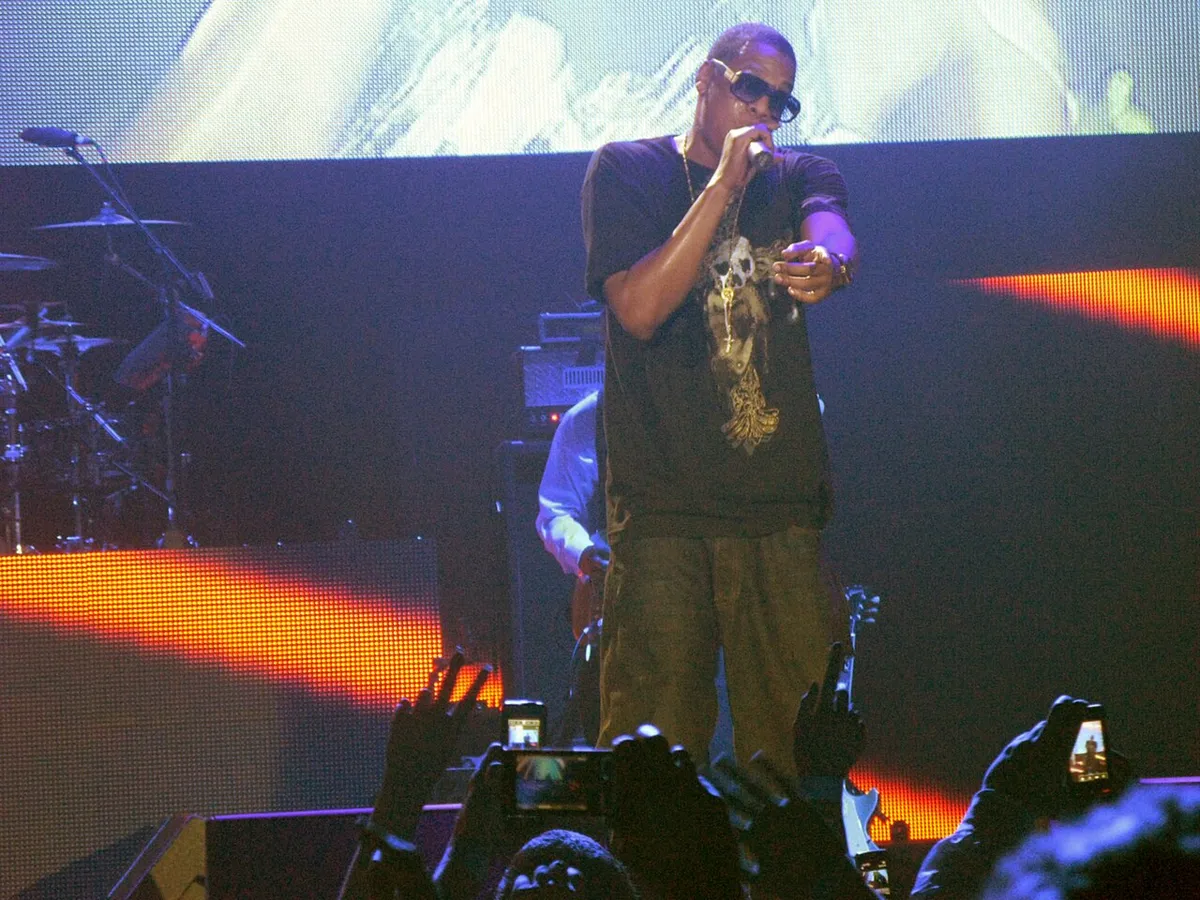
The Renegade Tectonic Shift
The atmosphere hit a breaking point midway through the set. As the haunting, mechanical grind of “Renegade” began to thrum through the floorboards, the collective intake of breath from 50,000 people was audible. For two decades, barbershop debates have raged over who truly owned this track—the lyrical architect or the Detroit assassin. When Eminem finally stepped into the spotlight, the debate became irrelevant. The raw, tectonic power of seeing these two titans share a stage for the first time in years was enough to send the Bronx into a literal frenzy. Marshall Mathers was a blur of kinetic energy, his double-time delivery as sharp and surgical as it was in the early aughts, trading haymakers with Jay-Z’s effortless, conversational flow.
“New York, you have no idea how much this means,” Eminem shouted, his voice echoing into the rafters after the final bar of “Renegade” faded. He didn’t give the crowd a second to breathe, immediately launching into a ferocious rendition of “Lose Yourself” that had the entire stadium vibrating in a singular, rhythmic bounce. Jay-Z stood back in the shadows of the stage, nodding along with a grin of genuine respect, a rare moment of hip-hop brotherhood on a scale that few other artists could ever hope to engineer.
The digital world felt the tremors instantly. On X (formerly Twitter), user @HovFanatic posted, “I just saw Jay-Z and Eminem perform Renegade live in 2026. I can die happy now. The energy is unmatched!” Meanwhile, @RapRadarNY echoed the sentiment, noting that the chemistry between the two legends hasn’t aged a day, calling the performance “the most significant live rap moment of the decade.”
Neptunes Funk and the Original Ruler
While the soul-sampling warmth of Kanye West defined much of The Blueprint, the night’s most infectious energy came courtesy of the Neptunes’ space-age bounce. Pharrell Williams, looking remarkably untouched by time in a custom Louis Vuitton ensemble, joined Jay-Z for a blistering run of hits that turned the ballpark into the world’s most exclusive outdoor club. The duo glided through “Excuse Me Miss” and the perennial anthem “I Just Wanna Love U (Give It 2 Me)” with a playful chemistry. Pharrell’s falsetto remained as smooth as polished marble, providing the melodic velvet to Jay-Z’s sandpaper grit. The two shared grins and inside jokes between verses, clearly relishing the chance to revisit the tracks that moved the culture at the turn of the millennium.
In a masterclass of lineage, the legendary Slick Rick made a surprise cameo to perform “La Di Da Di.” The historical symmetry was impossible to miss—Jay-Z’s “The Ruler’s Back” is a direct stylistic bow to Rick’s legacy, and seeing the two “Rulers” share the same oxygen felt like a torch-passing ceremony twenty-five years in the making. Slick Rick, draped in his trademark heavy gold, brought a touch of old-school majesty to the stadium, reminding the younger contingent that the house Jay-Z built sits on foundations laid by the pioneers.
The production was as colossal as the music. Towering LED screens flashed archival grainy footage from 2001, bleeding into live high-definition shots of the weeping, cheering crowd. The entire stadium was bathed in a specific, moody hue—Blueprint Blue—creating a visual cohesion that felt more like high-concept cinema than a standard rap show. From the gut-punch vulnerability of “Song Cry” to the arrogant, brassy swagger of “U Don’t Know,” Jay-Z navigated his catalog with the poise of a man who knows his place in the history books is not just written, but etched in stone.
A Legacy Bathed in Blue
As the final notes lingered, Jay-Z took a quiet moment at the edge of the stage. The bravado dropped for a second, replaced by something raw. He spoke briefly about the terrifying uncertainty of the world when the album first hit shelves in September 2001, and how these songs became a bridge back to normalcy for a broken city. “Twenty-five years ago, we were just trying to find our way,” he told the hush of the crowd. “To see all of you here tonight, in the heart of the Bronx, still rocking with me... it’s a blessing I never take for granted.”
Ultimately, this anniversary isn’t about metrics or chart history; it’s about the stubborn, enduring relevance of a body of work that refused to chase the zeitgeist and instead forced the zeitgeist to chase it. By summoning heavyweights like Eminem and Pharrell, Jay-Z didn’t just celebrate his own career—he mapped out the entire ecosystem of influence he has cultivated. The residency has one night left, and if Saturday was any indication, the Bronx has at least one more miracle left in its pocket. As the fans spilled out into the humid New York night, the blue glow of the stadium lights seemed to follow them home, a lingering ghost of an album that changed the world.


