 THE MARQUEE
The 808 didn’t just thump on “Planet Rock”; it announced a new civilization. Afrika Bambaataa, the Zulu King who weaponized the drum machine to save the Bronx from itself, has left the booth for the final time. On April 9, 2026, the heartbeat of global youth culture skipped a definitive, devastating rhythm. News of the pioneer’s passing broke through outlets like TMZ and the Associated Press, confirming that the 68-year-old visionary died in Pennsylvania following a quiet but grueling battle with cancer complications. For the acolytes who trace the history of hip-hop back to its humid, high-energy origins in the Bronx, Bambaataa was more than a DJ—he was the movement's high priest, the man who looked at a primitive circuit board and saw the future of the cosmos.
His departure marks the final silence for the “Holy Trinity” of hip-hop’s founding fathers, standing alongside DJ Kool Herc and Grandmaster Flash. While Herc provided the culture its physical sanctuary and Flash delivered its technical surgical precision, Bambaataa gave it an ideology and a futuristic, electronic soul. As fans and historians ignited the digital ether with clips of his legendary sets at the Bronx River Houses, the atmosphere shifted into one of somber reflection. We are mourning a man who fundamentally rewired how music is produced, consumed, and lived, turning the turntable into a pulpit for the space age.
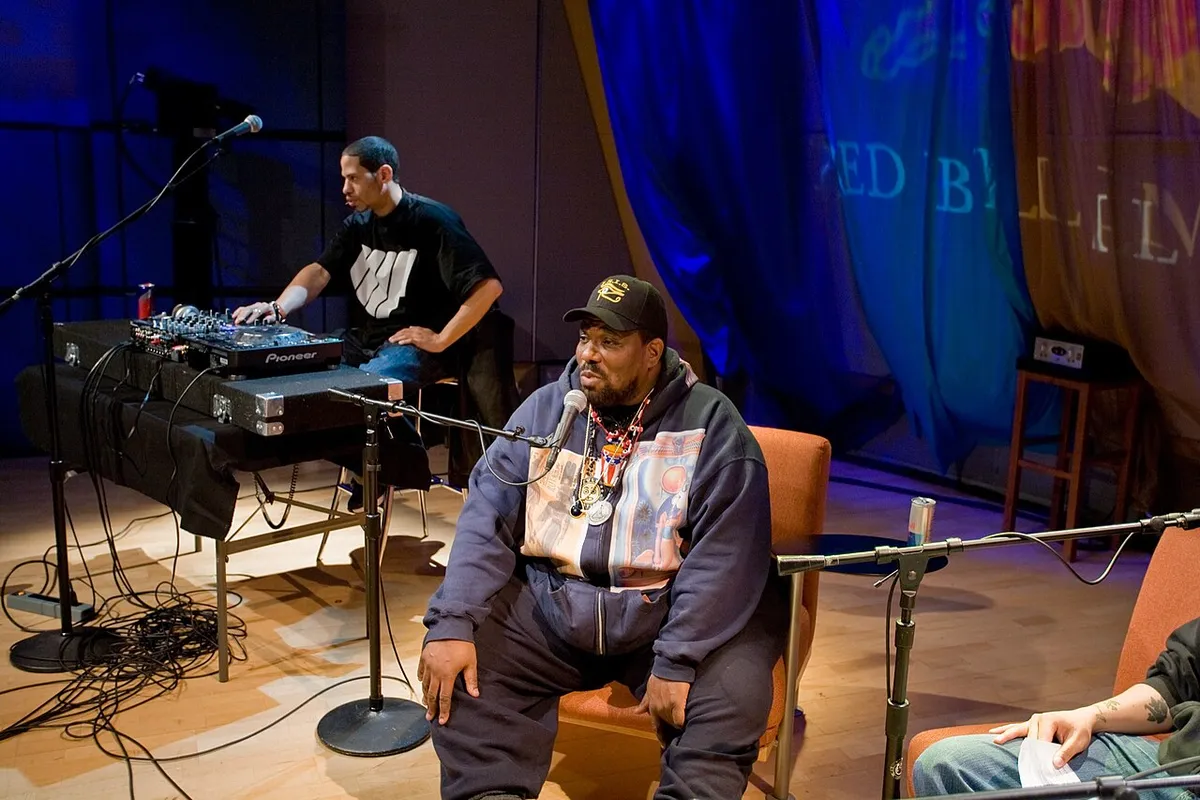
The Sonic Big Bang and the 808 Gospel
To grasp the tectonic weight of Bambaataa’s loss, you have to rewind to 1982. The music world was still picking through the wreckage of disco’s collapse when Bambaataa and the Soulsonic Force dropped “Planet Rock.” On paper, the track was a hallucination: a high-speed collision of Kraftwerk’s icy German precision and the raw, rhythmic sweat of New York City’s asphalt. Produced alongside Arthur Baker and John Robie, the track utilized the Roland TR-808 drum machine in a way that would dictate the terms of pop, rap, and dance music for the next forty years. That signature “boom” didn’t just rattle car trunks; it cracked the foundation of the recording industry wide open.
“He was the Master of Records,” Grandmaster Caz noted in a previous interview reflecting on the era’s wild-west energy. “Bam would play anything. He’d play rock, he’d play funk, he’d play African chants. He taught us that if the beat was right, it belonged to us.” This philosophy of radical inclusivity became hip-hop’s bedrock. By sampling everything from Ennio Morricone to Sly & The Family Stone, Bambaataa demolished the genre silos that had kept music segregated for decades. “Planet Rock” wasn't just a gold record; it was the blueprint for the electro-funk movement and the direct ancestor to the techno and house scenes that would soon explode in Detroit and Chicago.
Bambaataa’s influence stretched miles beyond the velvet slipmats. He was a social engineer disguised as a selector. Once a high-ranking member of the Black Spades gang in the Bronx, he saw the devastation of street violence firsthand. After a transformative pilgrimage to Africa—where he took the name Afrika Bambaataa Aasim from a 19th-century Zulu chief—he returned to New York with a mission to pivot that gangland energy into something creative, communal, and immortal. This was the messy, beautiful birth of the Universal Zulu Nation.
The Global Zulu State and the Pillar of Knowledge
The Universal Zulu Nation (UZN) wasn't some mere fan club; it was a sovereign state of mind. Under Bambaataa’s iron-clad leadership, thousands of young people across the globe traded their colors for microphones, their weapons for spray cans, and their frustration for cardboard breakdancing mats. He codified the four pillars of hip-hop—DJing, MCing, Breaking, and Graffiti—and famously added a fifth: Knowledge. His mantra of “Peace, Love, Unity, and Having Fun” became the official creed of a culture that the mainstream media was desperate to write off as inherently violent and ephemeral.
Throughout the 1980s and 90s, Bambaataa functioned as a street-level diplomat. He was the catalyst that brought hip-hop to the clubs of London and the streets of Tokyo, ensuring the local flavors of the Bronx remained intact even as they were exported. His performances were shamanic experiences, often featuring him in elaborate, Afro-futuristic regalia that predated the *Black Panther* aesthetic by decades. He was a shaman in a tracksuit, pulling together disparate tribes. The UZN chapters grew into a global network, proving that hip-hop was a universal language capable of bridging the most jagged racial and economic divides.
A Legacy Fractured: The Weight of Allegations
No honest accounting of Bambaataa’s life can ignore the dark shadow that eclipsed his sunset years. In 2016, a prominent activist and former UZN member, Ronald Savage, went public with shattering allegations, claiming Bambaataa had sexually abused him in the 1970s while Savage was a minor. These claims punctured a hole in the myth, leading to a flood of further allegations from other men who described a predatory pattern within the Zulu Nation’s inner circle. The fallout was total: Bambaataa was ousted from the organization he built, causing a massive, agonizing rift within the community he helped birth.
The wreckage was swift. In 2021, a civil lawsuit filed in New York under the Child Victims Act further cemented the legal and moral complexity of his narrative. For many, the music became haunted, making it impossible to separate the visionary from the alleged predator. Museums and cultural institutions found themselves in a deadlock over his artifacts, and many long-time collaborators retreated into a pained silence. This tension remains the uncomfortable center of his eulogy. How does a culture mourn a founding father whose alleged actions violated the very principles of “peace and unity” he spent a lifetime preaching?
Even as these allegations mutated his public image, his sonic DNA remained inescapable. Producers from Pharrell Williams to Dr. Dre have pointed to Bambaataa's early experiments as their primary North Star. The 808 sound he championed is the dominant texture of modern trap and pop. His passing in Pennsylvania comes as hip-hop is forced to look in the mirror, struggling with the mortality of its pioneers and the difficult, jagged truths of its history.
In his final years, Bambaataa largely vanished from the spotlight, grappling with the health issues that eventually claimed him. Sources close to the family noted that he remained obsessed with music until the end, often surrounded by the sprawling vinyl collections that made him a legend. While his final days were spent far from the neon glare of New York, the city he helped redefine continues to vibrate with his frequency. From the depths of the Brooklyn subways to the glass towers of Manhattan, the ghost of “electro-funk” is everywhere.
While the family has not yet announced a formal service, the streets are already providing the tribute. In the Bronx, DJs have spent the last 24 hours spinning the foundational breakbeats Bambaataa made immortal—Incredible Bongo Band’s “Apache” and James Brown’s “The Boss.” These sidewalk vigils are a reminder of the raw power he once held between two turntables and a mixer. He was a man of extreme contradictions: a peacemaker who rose from violence, a futurist who lived for the dusty grooves of the past, and a cultural hero whose personal history became a source of profound grief for many. The records will keep spinning, and the 808s will continue to thump in every corner of the map, but the man who first taught us how to search for the perfect beat has finally left the booth. The world of hip-hop is now left to navigate a future without its most influential, and most controversial, architect, leaving behind a legacy as loud and complicated as the life he led.


