 THE MARQUEE
By the time The Strokes hit the stage on April 18, 2026, the Empire Polo Club was supposed to be a playground for the neon-soaked and the over-caffeinated. Coachella’s second weekend usually smells like high-end sunscreen and expensive dust, a curated victory lap for the industry’s elite. But as the Ferris wheel spun in the distance like a glowing relic of a simpler era, the kings of New York indie rock decided they weren’t interested in being your Saturday night distraction. What started as a masterclass in leather-jacket cool quickly devolved—or perhaps evolved—into a jagged, uncompromising political assault that left the influencer-heavy crowd stunned into silence.
The night began with the expected swagger of Julian Casablancas, Nick Valensi, Albert Hammond Jr., Nikolai Fraiture, and Fabrizio Moretti. They looked every bit the part of rock royalty, but the atmosphere curdled during the night’s finale, the shimmering, synth-heavy pulse of “Oblivius,” a standout from their 2016 Future Present Past EP. Just as Valensi and Hammond Jr. began weaving their signature interlocking guitar patterns, the massive LED screens abandoned their psychedelic dreamscapes. In their place, a rapid-fire visual blitzkrieg took over, trading Coachella’s “vibes” for the cold, hard receipts of geopolitical carnage. This wasn’t just a background visual; it was a guerrilla-style documentary exposé flickering at the speed of light.
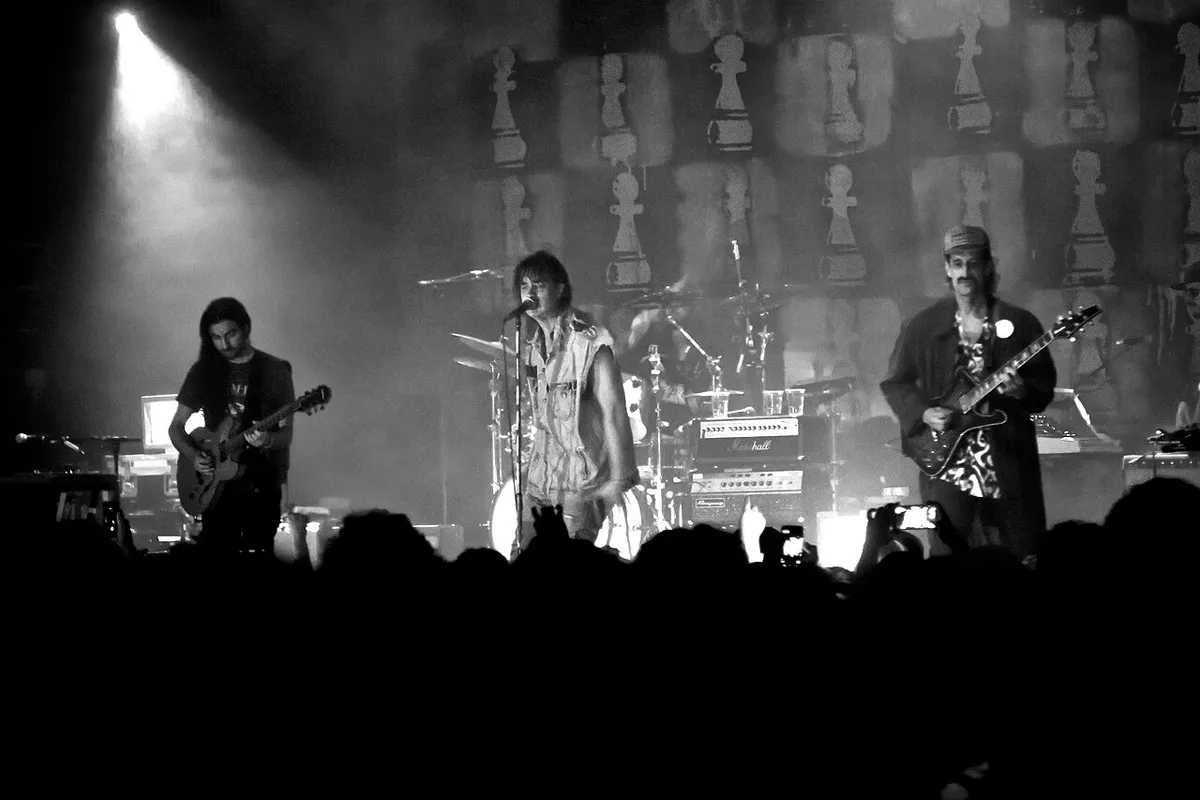
The Visual Guerrilla War
The imagery was relentless, a strobe-light headache of declassified history. While Casablancas leaned into his whiskey-soaked, effortless drawl, the screens behind him were shouting. The montage took aim squarely at decades of U.S. interventionism, explicitly naming the CIA in a series of slides that detailed historical coups and the systematic removal of democratically elected leaders. In the front rows, thousands of iPhones—initially raised to capture a piece of indie-rock nostalgia—remained frozen in the air. The realization hit that these weren't technical glitches. The band was using their headlining power to broadcast the destruction of universities in Iran and Gaza, the stark text highlighting a human and intellectual vacuum that left a visceral chill hanging over the desert heat.
The true lightning rod, however, was a specific and searing reference to the 1999 Memphis civil trial regarding the assassination of Dr. Martin Luther King Jr. The video prominently cited the unanimous jury verdict that found a conspiracy involving various agencies of the U.S. government. For a festival audience often criticized for prioritizing aesthetic over substance, the inclusion of such heavy, legally-charged historical claims felt like a deliberate slap in the face. On social media, the reaction was immediate and polarized. Half the feed was a frantic scramble of praise for the band’s “truth-telling,” while the other half was a cacophony of critics claiming a Saturday night in the desert wasn't the place for a lecture on the military-industrial complex.
“The Strokes didn’t just play a set, they dropped a lecture notes package on the entire history of American shadow ops,” one fan posted on X. It was a fascinating evolution for a group that first burst out of the Lower East Side as the poster boys for disaffected, too-cool-to-care rock. Today, they are leaning into a new role: the elder statesmen of dissent.
Information Wars and the Empire State of Mind
None of this should come as a complete shock to anyone who has been tracking Casablancas’ trajectory. The frontman has spent the last several years using his platform—both with The Strokes and The Voidz—to rail against corporate media monopolies and wealth inequality. But this Coachella performance felt coordinated, a tactical escalation. By zeroing in on the demolition of Iranian and Palestinian educational institutions, the band tapped into the raw nerve of the student-led protests and academic crises that have defined the cultural landscape of 2025 and 2026. They targeted a specific kind of intellectual loss, speaking directly to the younger, politically energized demographic in the pit.
Musically, the band was tighter than a drum, providing a professional, polished backbone to the visual chaos. The arrangement of “Oblivius” felt sharper and more urgent, its soaring chorus serving as a haunting soundtrack to images of ruins and redacted documents. Casablancas kept his between-song banter cryptic but pointed. At one point, he stared into the middle distance and acknowledged the “information war” he believes is being waged against the public. While they’ve flirted with this before—most notably at their 2020 rally for Bernie Sanders—the Coachella set felt more global, more furious, and significantly more confrontational.
The decision to unleash this on Weekend 2 was the ultimate power move. While Weekend 1 is the celebrity-stacked, polished debut, Weekend 2 is for the die-hards—the fans more likely to actually process the message rather than just hunt for a photo op. By waiting until the second Saturday, The Strokes ensured their manifesto would be the definitive talking point of the festival’s final hours. It forces a heavy question for 2026: is the artist’s job to provide an escape, or to act as a mirror to the world's wreckage?
Industry insiders are already whispering about how Goldenvoice will handle the fallout. The festival has seen political moments from the likes of Roger Waters and Childish Gambino, but the sheer specificity of the accusations regarding the CIA and foreign bombings is a direct challenge to the festival circuit’s status quo. As the band closed with “Oblivius,” the track served as a literal epilogue for the manifesto they had just screened. As the crowds finally trickled out toward the parking lots, the chatter wasn't about the setlist or the fashion. It was about the screens. The Strokes proved that after 25 years, they still have the power to unsettle, reminding everyone that the music is often just a delivery system for something much louder.


