 THE MARQUEE

The voice that defined a future we actually wanted to live in has fallen silent. Sir Patrick Stewart, the man who transformed a starship captain into a philosopher-king and a mutant mentor into a beacon of hope, took his final bow on Wednesday, October 28, 2026, at his home in Los Angeles. He was 86. His longtime spokesperson, Kelly Bush Novak, confirmed the news Thursday, noting that Stewart passed away peacefully following a brief but intense journey with Alzheimer’s disease and Lewy body dementia.
For millions of fans, Stewart wasn't just an actor; he was a moral compass in an increasingly chaotic world. Whether he was tugging at his uniform as Captain Jean-Luc Picard on the bridge of the USS Enterprise or projecting a serene, telepathic authority as Professor Charles Xavier in the X-Men franchise, Stewart possessed the rare gravitational pull required to make high-concept science fiction feel like profound human truth. He didn’t just play leaders; he embodied the very idea of dignity under pressure. The news of his passing triggered a visceral wave of grief across the globe, with the hashtag #Engage trending within minutes as fans shared clips of his most stirring orations.
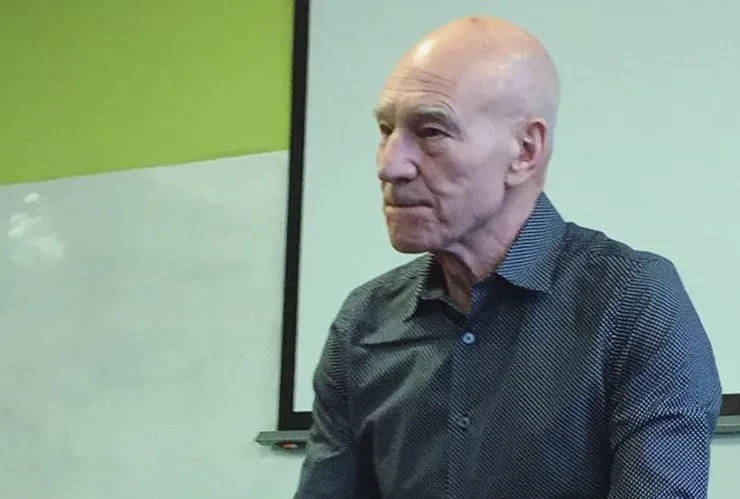
His departure marks the end of an era for the Star Trek family, a group that had long since transcended the status of mere castmates. Jonathan Frakes, who played William Riker, Stewart’s right-hand man for seven seasons of The Next Generation and multiple films, took to X (formerly Twitter) to share a simple, heartbreaking photo of the two of them sharing a laugh on set. “My captain, my mentor, my dear, dear friend,” Frakes wrote. “The stars shine a little less brightly tonight.” Fellow co-stars LeVar Burton and Brent Spiner also weighed in, noting that Stewart’s arrival in Hollywood in the late 1980s didn't just boost ratings—it fundamentally altered the DNA of television drama by injecting Shakespearean gravitas into the small screen.
The Bard of the Bridge: From the RSC to Warp Drive
It is difficult to reconcile the global icon we knew with the fact that, in 1987, Patrick Stewart was virtually unknown in America. Born July 13, 1940, in Mirfield, Yorkshire, he spent decades as a tireless stalwart of the Royal Shakespeare Company. He viewed himself as a “jobbing actor,” a man whose destiny was the boards of the West End, not a neon-lit soundstage in California. When Star Trek creator Gene Roddenberry began casting for The Next Generation, he was famously skeptical of the bald, intense Englishman. Roddenberry wanted a leading man with a traditional Hollywood mane, even forcing Stewart to wear a toupee during his initial screen tests. But Stewart’s presence was undeniable. He brought a weight to Jean-Luc Picard that the genre had never seen, evolving the character into a warrior-poet who would always reach for a diplomatic solution before a phaser.
Stewart often delighted in telling audiences that he expected the show to be a spectacular failure. He kept his bags packed for the first two seasons, certain he’d be back in London by Christmas. Instead, he became the face of a phenomenon. Masterpiece episodes like “The Inner Light,” where Picard lives an entire lifetime on a dying planet within a few minutes, showcased Stewart’s staggering range and cemented the series as a cultural powerhouse. Even after the show wrapped in 1994, the character remained his shadow. He revisited Picard in four feature films and eventually the Paramount+ series Picard, where he explored the character’s vulnerability and the quiet indignities of aging—a creative choice that resonated deeply with fans who had grown gray alongside him.
Off-screen, Stewart’s life was as vibrant and unexpected as his career. He was knighted by Queen Elizabeth II in 2010 for his services to drama, an honor he wore with immense pride but zero pretension. He found a joyful second act in his marriage to singer-songwriter Sunny Ozell, whom he met in 2008 while performing in Macbeth at the Brooklyn Academy of Music. Together, they became unlikely internet sensations, known for their playful videos and Stewart’s late-blooming passion for fostering pit bulls. These glimpses of his domestic life humanized the man often seen as the stoic face of the Federation. His 2023 memoir, Making It So, peeled back even more layers, detailing his working-class roots and a complicated relationship with his father, proving that his legendary strength was forged in real-world adversity.
The Mind of a Mentor and a Legacy of Advocacy
Just as a new generation was discovering him through Star Trek syndication, Stewart doubled down on his blockbuster status by stepping into the wheelchair of Charles Xavier in 2000’s X-Men. Director Bryan Singer knew there was only one actor who could project the necessary telepathic authority, and Stewart delivered. His on-screen chemistry with Sir Ian McKellen, who played Magneto, is the stuff of cinema legend. These two Shakespearean titans took a comic book movie and turned it into a sophisticated meditation on civil rights and conflicting ideologies. Their real-life “bromance”—documented through snapshots of them in matching bowler hats or wandering Coney Island—became a beloved staple of celebrity culture, proving that even rival mutants could be best friends.
Stewart’s portrayal of Xavier reached its emotional peak in the 2017 masterpiece Logan, where he played a version of the character suffering from a degenerative brain disease. In a cruel twist of irony, that performance—shattered, brilliant, and heartbreakingly frail—foreshadowed the health struggles he would face in his final years. While his diagnosis of Alzheimer’s and Lewy body dementia was kept private for as long as possible, those in his inner circle say he approached the illness with the same curiosity and grit he brought to every role. He became a quiet advocate for neurological research, lending his still-powerful voice to the Alzheimer’s Association even as his own memories began to drift away.
Even as his physical pace slowed, Stewart never lost his razor-sharp wit. His voice work in American Dad! as the delightfully unhinged Deputy Director Avery Bullock allowed him to puncture his own serious image, much to the joy of fans who loved seeing the “Serious Actor” lean into total absurdity. Beyond the jokes, he used his platform for genuine social change, speaking out against domestic violence and championing Amnesty International. He was a man who understood the weight of his own celebrity and refused to let it be wasted on vanity, always steering the spotlight toward the causes that mattered most.
Setting Course for the Great Unknown
Despite his Hollywood dominance, Stewart’s heart never truly left the theater. At the height of his fame, he would routinely return to New York or London for limited runs of Shakespeare or Pinter. His legendary one-man show of A Christmas Carol, in which he inhabited every character with nothing but a chair and a book, remains a masterclass in the craft of acting. He was the ultimate actor’s actor, capable of commanding a room of thousands with a mere whisper. When he stepped onto a set, the atmosphere shifted; younger stars like Hugh Jackman and Tom Hardy frequently spoke of the “education” they received just by standing in his presence.
As news of his passing continues to ripple through the industry, the tributes have been as grand as the man himself. The official Star Trek account posted a tribute simply stating, “He made it so. Rest in peace, Sir Patrick.” Even NASA joined the mourning, tweeting a photo of a distant nebula with a caption that summed up his impact: “To a man who inspired us to look up and wonder what lies beyond. Godspeed, Sir Patrick Stewart.” It is a testament to his legacy that he is mourned by scientists and dreamers alike.
Sir Patrick Stewart’s journey was a masterclass in evolution. He began in a small Yorkshire town and ended as a knight of the realm and a commander of the stars. He leaves behind his wife, Sunny, his children Daniel and Sophie, and a body of work that will be studied for as long as we tell stories. While the man himself has moved on to the final frontier, the echoes of his voice—commanding, compassionate, and eternally curious—will resonate through the corridors of the Enterprise and the halls of Xavier’s School for Gifted Youngsters forever. He didn't just play a hero; he reminded us that the most important frontier is the one within ourselves. Set a course for the second star on the right, and straight on 'til morning.


