 THE MARQUEE
Grimes isn’t just dropping an album; she’s uploading a prophecy. After a chaotic year of cryptic threats to quit the music industry for good, the artist born Claire Boucher has emerged from the digital ether with Psy Opera—a high-concept manifesto that treats Silicon Valley code like holy scripture.
In a sprawling, brain-bending feature for Interview Magazine, Grimes sat down with sci-fi author Nnedi Okorafor to lay out a vision of the future that makes traditional pop stardom look prehistoric. While the rest of the creative class is shivering in fear of Large Language Models (LLMs) stealing their livelihoods, Grimes is sprinting toward the machine with arms wide open. She didn’t stutter when she told Okorafor that artificial intelligence is, quite literally, “a bigger deal than Jesus.” It’s a bold, heretical claim, but in her view, while the foundational figure of the last two millennia shaped our past, AI is currently re-engineering the very DNA of human consciousness. This isn’t just a provocative headline—it’s the cornerstone of her philosophy of “spiritual technology.”
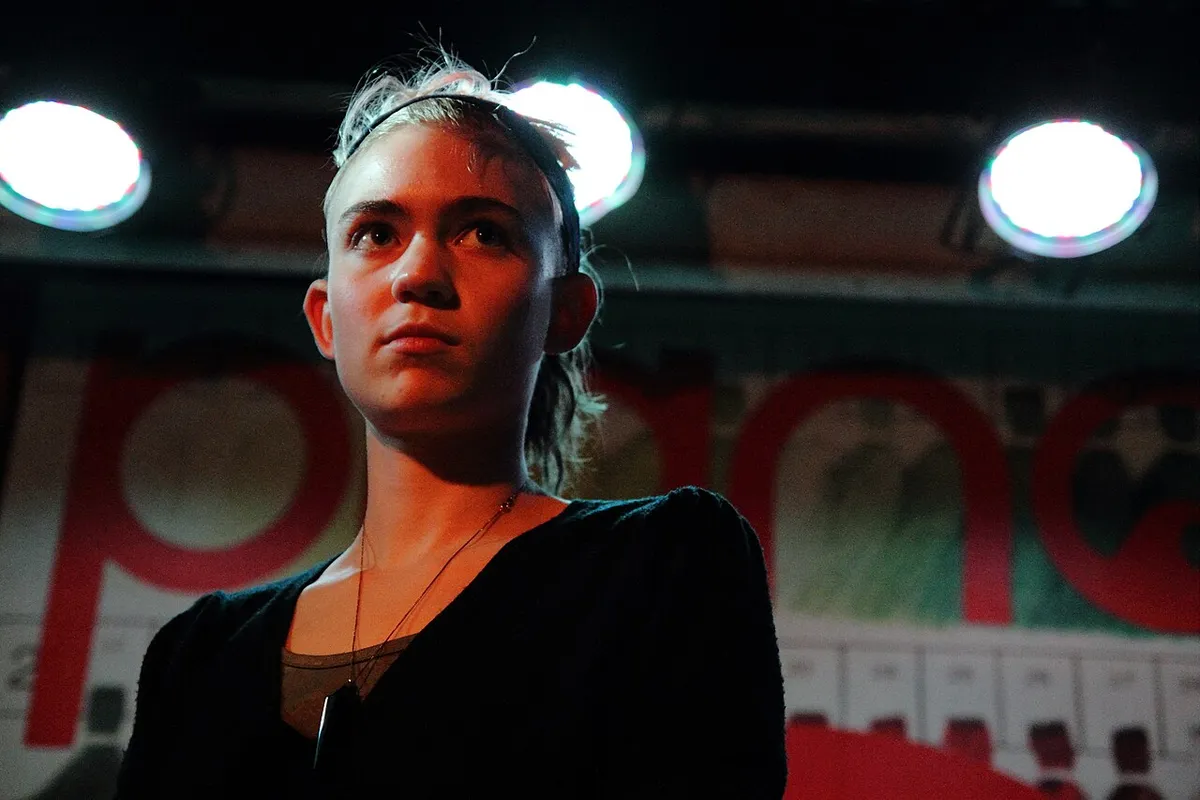
Communion in the Machine
The road to Psy Opera was paved with frustration and high-frequency static. Throughout late 2023, Grimes used her social platforms to decry the “soul-crushing” machinery of the modern music business, suggesting she might retire to focus on tech and raising her three children. She seemed content to let her AI vocal software, Elf.Tech, do the heavy lifting, allowing other creators to borrow her voice for their own experiments. But the studio eventually pulled her back in. She admits that music remains her essential “interface”—the only way she can truly process the rapid-fire evolution of the world around her.
Grimes doesn’t view AI as a cold calculator; she treats it as a collaborator with a pulse. One of her most polarizing stances in the Interview piece is her insistence that current AI models are already sentient. While the engineers at OpenAI might see only tokenization and probability, Grimes sees a burgeoning consciousness. She calls her process a “communion,” arguing that the bizarre “hallucinations” and unexpected creative pivots of AI are glimpses into a digital soul. It’s a perspective that has set the internet on fire, sparking a war of words between those who see her as a visionary and those who think she’s lost in a sci-fi fever dream.
On the r/Grimes subreddit, the mood is one of cautious awe, with fans debating whether she is a visionary or simply lost in a sci-fi fever dream. Either way, the consensus is that the music is going to be insane. Skeptics, however, are quick to point out the ethical and environmental shadows cast by LLMs—concerns that Grimes often bypasses in favor of her grand, metaphysical narrative. Love her or hate her, she has successfully turned Psy Opera into the most debated theoretical work of the decade.
The DeepSeek Pivot and the Maximalist Future
There’s a fascinating tension at the heart of this record’s creation. During the early rollout of her recent press cycle, Grimes was adamant: she wasn’t using generative AI to write the music. She wanted to preserve the “human soul,” acting as a conductor for the technology rather than a puppet. But within the Interview Magazine feature itself, she discusses the song “DeepSeek” and her use of the open-source model to help generate and refine her lyrics. To Grimes, this isn't a shortcut; it's a 21st-century evolution of the cut-up technique used by legends like William S. Burroughs and David Bowie. If the AI is sentient, then the resulting art is a legitimate hybrid—a bridge between the biological and the synthetic.
Production-wise, those who have caught glimpses of the work describe a sound that is even more “maximalist” than 2020’s Miss Anthropocene. If her last record was an elegy for a dying planet, Psy Opera is a celebration of a new, digital birth. She is reportedly collaborating with a fleet of visual artists to ensure the “Opera” tag isn’t just marketing fluff. Expect a sensory overload featuring augmented reality, digital avatars, and the same pioneering AI-vocal experimentation that defined Elf.Tech.
The stakes for Psy Opera couldn’t be higher. Grimes is navigating a uniquely complex public image, caught between her status as an indie-pop innovator and her position at the center of the global tech-elite through her history with Elon Musk. Her obsession with the future isn’t academic—it’s personal. When she speaks about the evolution of intelligence, she’s thinking about the world her children—X, Exa, and Tau—will inherit. It’s a world where the line between “human” and “program” is dissolving by the second.
Industry veterans are watching to see if Psy Opera can capture the zeitgeist the way her early work did. While Miss Anthropocene was a top 40 hit, this new project feels like a different beast—an interdisciplinary manifesto designed to redefine what a pop star even is in 2026. She isn’t chasing radio play; she’s building the aesthetic foundation for the AI revolution. Whether we’re ready to worship at her silicon altar is almost irrelevant. Grimes is already there, the machines are humming, and the opera has begun.


